
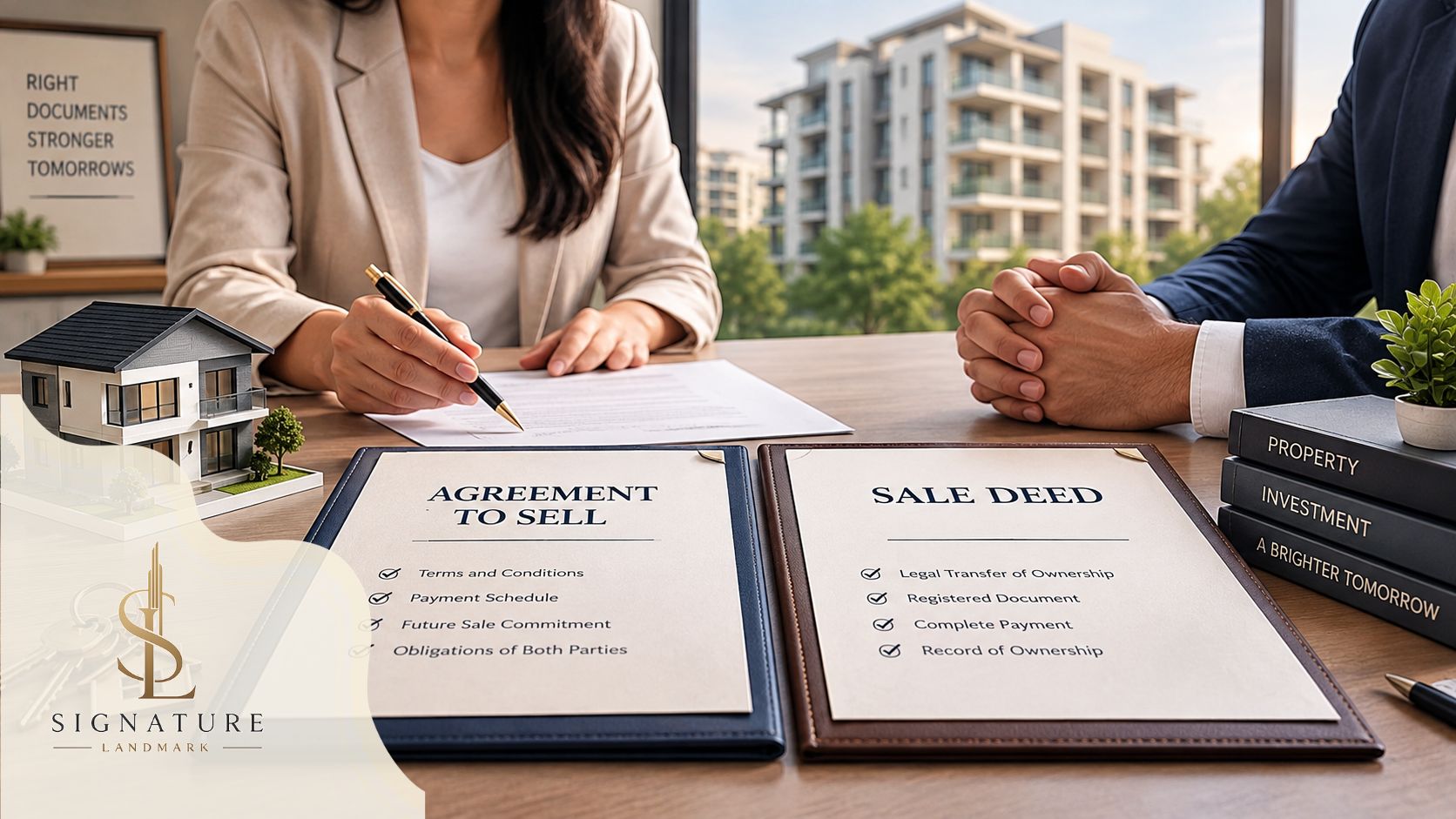

Buying or selling a property involves several legal documents, but two of the most important are the Agreement to Sell and the Sale Deed. Although these terms are sometimes used interchangeably, they serve very different purposes.
Understanding the difference between a Sale Deed and an Agreement to Sell can help property buyers and sellers avoid confusion, financial risks, and legal complications.
In this article, we explain the meaning, purpose, legal importance, and key differences between a sale deed and an agreement to sell.
What Is an Agreement to Sell?
An agreement to sell is a legal document in which the buyer and seller agree to the terms and conditions of a future property transaction.
It generally contains details such as
- Property description
- Agreed sale price
- Payment schedule
- Advance or token amount
- Date of execution of the Sale Deed
- Responsibilities of the buyer and seller
- Conditions that must be fulfilled before the final sale
- Consequences of failure to complete the transaction
The Agreement to Sell represents an intention to complete the sale in the future. It does not, by itself, transfer ownership of the property to the buyer.
For example, if a buyer agrees to purchase a house for ₹50 lakh and pays ₹5 lakh as an advance, the parties may sign an Agreement to Sell stating that the remaining amount will be paid and the Sale Deed will be executed on a specified date.
What Is a Sale Deed?
A Sale Deed is the primary legal document used to transfer ownership of a property from the seller to the buyer after the agreed terms have been fulfilled.
It normally includes:
- Names and details of buyer and seller
- Complete property description
- Sale consideration
- Payment details
- Transfer of ownership
- Rights and liabilities of both parties
- Property possession details
- Signatures of the parties and witnesses
The Sale Deed is generally executed after the buyer has fulfilled the payment conditions and other requirements specified in the Agreement to Sell.
For immovable property, the transfer is ordinarily completed through a properly executed and registered sale deed, subject to applicable law.
Sale Deed vs Agreement to Sell: Key Differences
| Basis | Agreement to Sell | Sale Deed |
|---|---|---|
| Purpose | Agreement for a future sale | Completion of the property sale |
| Ownership | Does not ordinarily transfer ownership | Transfers ownership, subject to applicable law |
| Timing | Usually signed before the final sale | Usually executed after the sale |
| Payment | May involve advance/token payment | Usually records/reflects agreed sale consideration and payment |
| Legal role | Sets out future obligations | Records the completed transfer |
| Registration | Registration requirements depend on its terms and applicable law | Generally requires registration for transfer of title in immovable property |
| Possession | May or may not be given | Can record delivery of possession |
| Consequence | Creates contractual obligations | Establishes the completed conveyance |
Is an Agreement to Sell Necessary Before a Sale Deed?
An agreement to sell is not necessarily required in every property transaction. However, it can be extremely useful, particularly when the transaction involves a substantial time gap between the initial agreement and final registration.
It gives both parties a clear understanding of the following:
- How much money will be paid
- When payments will be made
- When possession will be handed over
- When the Sale Deed will be registered
- What happens if either party fails to perform their obligations
A properly drafted agreement can therefore reduce misunderstandings between buyers and sellers.
Why Is the Sale Deed Important?
The Sale Deed is one of the most important documents in a property transaction because it records the actual transfer of ownership.
After execution and registration, the buyer should preserve the original or legally valid registered document carefully. It may be required for future transactions, loans, mutation, taxation, or establishing ownership.
Before signing the sale deed, buyers should also verify the property's title, approvals, encumbrances, tax records, and other relevant documents.
Common Mistakes to Avoid
Property transactions involve significant financial commitments. Buyers and sellers should avoid the following mistakes:
1. Signing Without Reading
Never sign an agreement to sell or a sale deed without carefully reviewing all terms and conditions.
2. Ignoring Property Documents
Check the seller's ownership documents, title history, encumbrance information, approvals, and applicable property records.
3. Not Mentioning Payment Details
The agreement should clearly state the sale consideration, advance payment, remaining amount, and payment schedule.
4. Delaying Registration
Once the transaction is ready for completion, ensure that the sale deed is executed and registered in accordance with applicable legal requirements.
5. Relying Only on Verbal Promises
Important promises regarding possession, fixtures, payment, construction, or other conditions should be properly documented.
Which Document Is More Important?
Both documents are important, but they have different functions.
The Agreement to Sell establishes the terms of a proposed future transaction, while the Sale Deed is the document that ordinarily completes the transfer of ownership of immovable property.
Therefore, buyers should understand both documents instead of treating them as the same.
Conclusion
Understanding the difference between a Sale Deed and an Agreement to Sell is essential for anyone buying or selling property. An agreement to sell primarily establishes the terms and obligations for a future transaction, while a sale deed records the final transfer of ownership.
Before entering into a property transaction, buyers and sellers should carefully verify the documents, payment terms, property title, registration requirements, and applicable local laws.
For major property transactions, it is advisable to seek professional legal advice and have the documents reviewed by a qualified property lawyer before signing.
Signature Landmark aims to help property buyers and sellers make informed real estate decisions with greater clarity and confidence.