
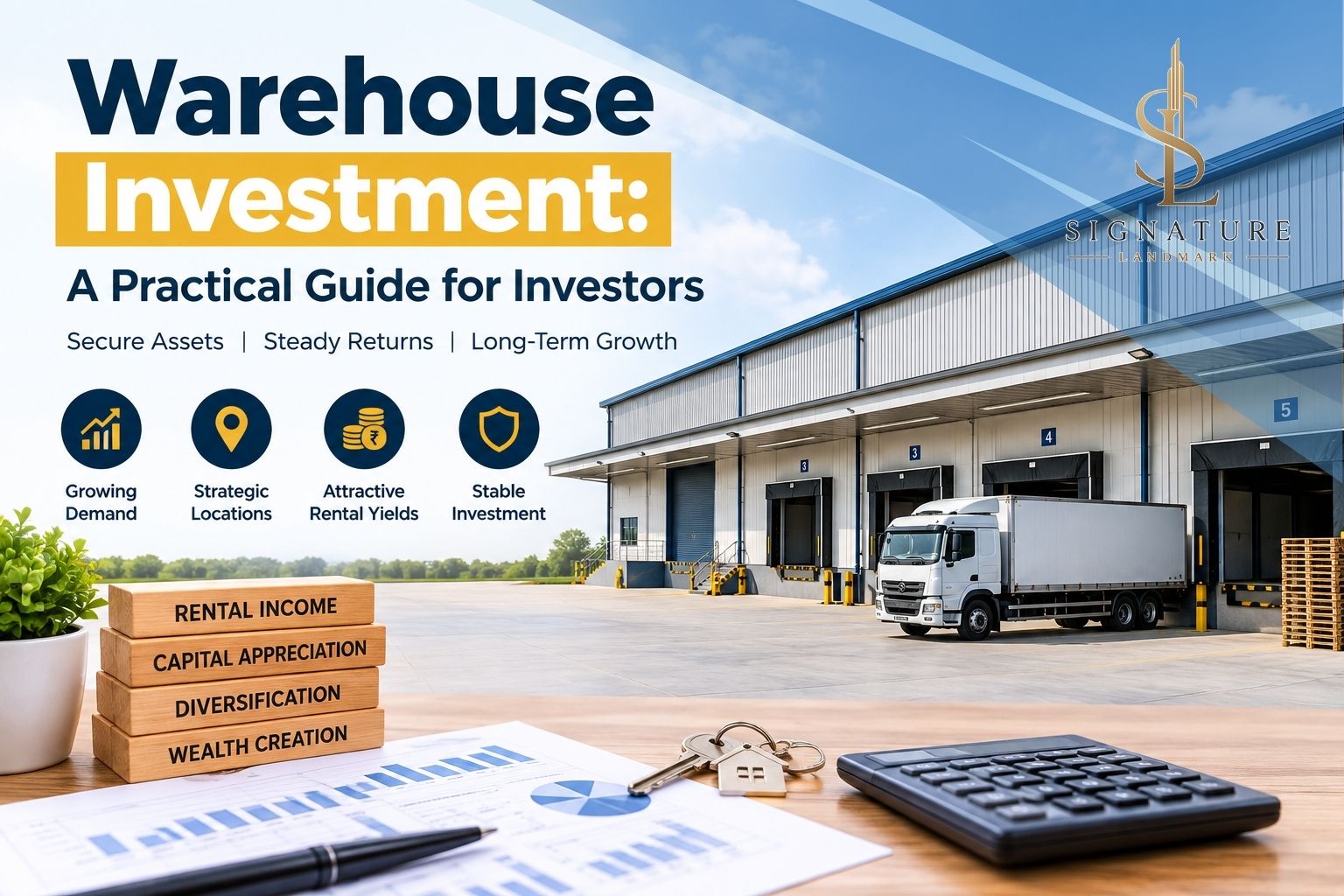

Warehouse investment is becoming an increasingly important segment of commercial real estate. As e-commerce, manufacturing, retail, logistics, and organized distribution networks continue to expand, businesses need strategically located spaces to store, manage, and distribute goods efficiently. For investors, warehouses can provide an opportunity to participate in the growing demand for logistics and industrial infrastructure.
Unlike residential properties, warehouse investments are primarily driven by business activity, location, connectivity, tenant demand, and operational efficiency. Understanding these factors can help investors evaluate whether a warehouse property fits their long-term investment objectives.
What Is Warehouse Investment?
Warehouse investment involves purchasing, developing, or investing in properties designed for storage, distribution, logistics, or related commercial activities. These properties may range from small storage facilities to large modern logistics parks and industrial warehouses.
Investors can generate returns through rental income, property appreciation, or a combination of both. The potential performance of a warehouse depends heavily on its location, construction quality, tenant profile, lease terms, and demand within the surrounding market.
Why Consider Warehouse Investment?
One of the major attractions of warehouse investment is the growing requirement for efficient supply-chain infrastructure. Businesses increasingly depend on warehouses located close to highways, cities, manufacturing clusters, consumption centers, and transportation hubs.
Long-term leases can also provide relatively predictable rental income when the property has a suitable tenant and a well-structured lease agreement. Compared with some other commercial properties, a warehouse may have fewer day-to-day customer-facing requirements, depending on its use and tenant.
Another potential advantage is capital appreciation. Well-located warehouse properties may benefit from improvements in infrastructure, road connectivity, industrial development, and expansion of nearby commercial zones.
Location Is a Key Factor
Location is one of the most important considerations when evaluating a warehouse. A strategically located property can be more attractive to logistics operators and businesses because transportation costs and delivery times can be reduced.
Investors should examine proximity to major highways, ring roads, airports, railway networks, industrial areas, wholesale markets, and urban consumption centers. Road accessibility is particularly important because warehouses often handle heavy commercial vehicles.
Emerging logistics corridors can also offer opportunities, but investors should carefully assess whether planned infrastructure projects are approved, funded, and progressing before making investment decisions.
Important Features of a Good Warehouse
A warehouse should meet the operational requirements of potential tenants. Important features may include adequate floor space, sufficient ceiling height, loading and unloading areas, parking for commercial vehicles, fire-safety systems, security, ventilation, electricity, drainage, and internal roads.
Modern businesses may also look for technology-enabled facilities, efficient lighting, temperature-control systems, or specialized storage infrastructure depending on the type of goods handled.
The property's design should support smooth movement of goods and vehicles. A poorly planned warehouse may become difficult to lease even if it is located in a growing area.
Understanding Rental Income and Lease Terms
Before purchasing a warehouse as an investment, investors should carefully study the expected rental income and lease structure. Important factors include monthly rent, lease duration, security deposit, rent escalation, maintenance responsibilities, taxes, insurance, renewal clauses, and exit conditions.
A long-term lease with a financially reliable tenant may provide greater income visibility, but investors should not evaluate a property only based on lease duration. The tenant's business strength, the property's marketability, and the possibility of finding another tenant in the future are also important.
Investors should calculate potential returns after considering vacancies, maintenance expenses, property taxes, financing costs, insurance, and other applicable expenses.
Risks to Consider
Warehouse investment also carries risks. Demand can vary depending on economic conditions, industrial activity, logistics trends, and local development.
A property located in an area with limited road access or weak tenant demand may experience longer vacancy periods. Older warehouses may also require significant investment for repairs, upgrades, or compliance requirements.
Legal and regulatory due diligence is essential. Investors should verify ownership documents, land use, building approvals, development permissions, fire and safety requirements, access rights, property taxes, and other applicable regulations before completing a transaction.
Warehouse Investment and Emerging Markets
Growing cities and developing industrial corridors can create new opportunities for warehouse investment. As businesses expand beyond major metropolitan areas, demand for strategically positioned logistics facilities can increase.
For example, investors evaluating warehouse opportunities around developing commercial or industrial areas should examine population growth, manufacturing activity, transportation infrastructure, upcoming projects, and existing warehouse demand rather than relying solely on future expectations.
Local market research can provide valuable insights into rental rates, vacancy levels, tenant requirements, and competing properties.
How to Evaluate a Warehouse Investment
A systematic evaluation can help investors make a more informed decision. Start by identifying the property's location and accessibility. Next, examine the building's condition, specifications, legal status, and operational features.
Compare the property's purchase price with prevailing market values and rental rates. Calculate expected rental yield and consider possible vacancy periods and operating expenses.
It is also useful to study nearby warehouses and understand what types of businesses are occupying them. Speaking with experienced commercial real estate professionals can provide additional market information.
Conclusion
Warehouse investment can be an important part of a diversified commercial real estate strategy. Increasing demand for logistics, e-commerce, manufacturing, retail distribution, and supply-chain infrastructure is supporting interest in warehouse properties.
However, successful investment requires more than simply purchasing a large property. Location, connectivity, tenant demand, construction quality, lease terms, legal documentation, operating costs, and future market conditions should all be carefully evaluated.
Whether you are considering a ready warehouse, a leased property, or land for warehouse development, thorough due diligence is essential. With proper research and professional guidance, investors can better understand the opportunities and risks associated with this segment of commercial real estate.