
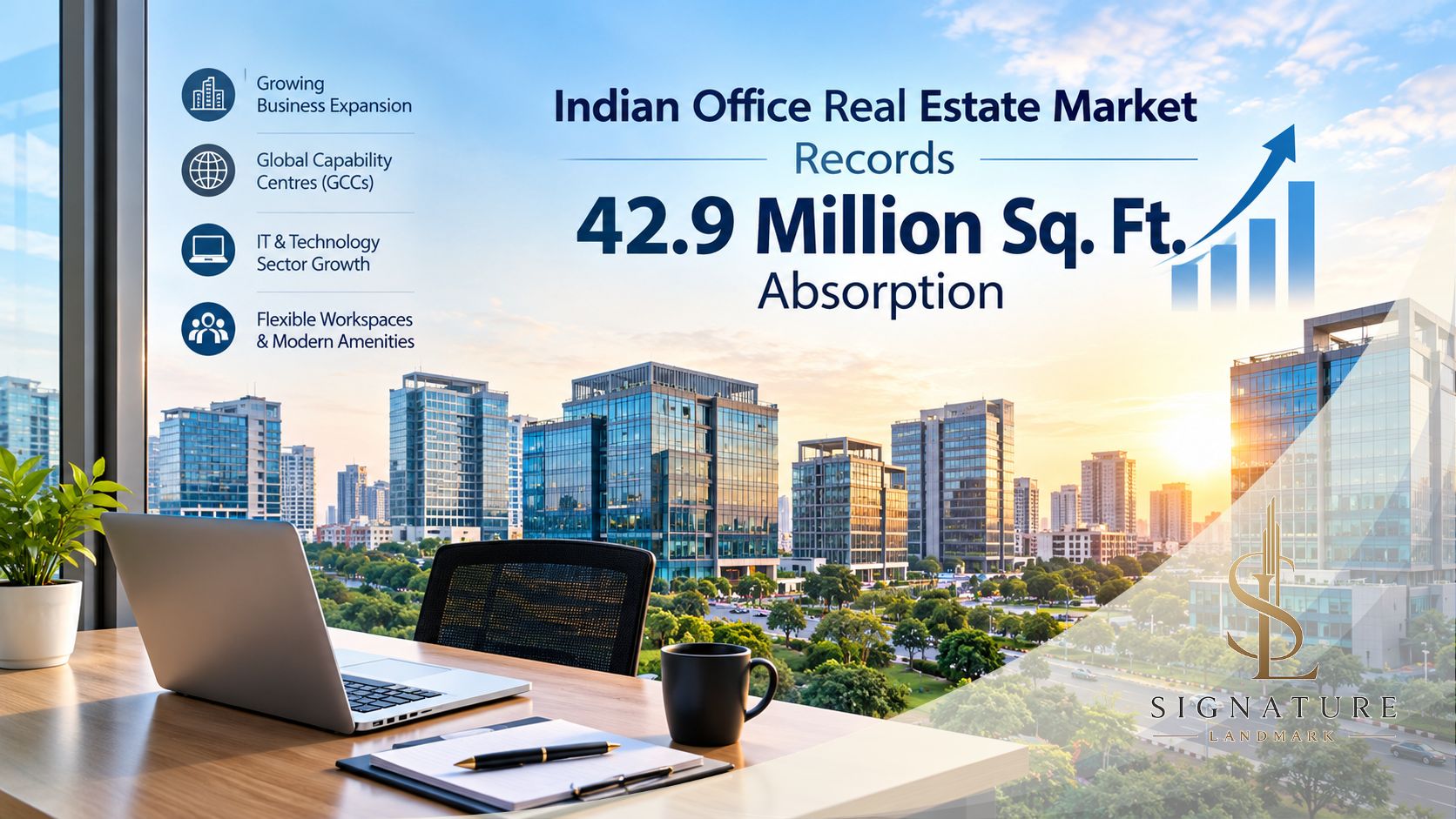

India’s commercial real estate sector is witnessing significant growth as businesses expand, multinational companies strengthen their presence, and demand for high-quality office spaces continues to rise. The reported office space absorption of 42.9 million square feet highlights the growing importance of India as a destination for corporate offices, global capability centres (GCCs), technology companies, and professional services.
This development reflects the changing nature of India’s office market, where businesses increasingly seek modern workplaces with better connectivity, advanced infrastructure, energy efficiency, and employee-friendly facilities. For property investors, developers, and business owners, this trend presents important opportunities in the commercial real estate sector.
1. Understanding Office Space Absorption
Office space absorption refers to the amount of office space occupied or leased by businesses during a specific period. It helps measure the actual demand for commercial properties and indicates how actively companies are expanding or relocating their operations.
The reported absorption of 42.9 million square feet demonstrates substantial demand for office premises across India's major commercial markets. However, the exact period covered by this figure is important when comparing it with previous years or interpreting it as a record.
Unlike new office supply, which measures the space added to the market, absorption reflects how much space businesses are taking up. Strong absorption can support rental growth, improve occupancy levels, and encourage developers to plan new commercial projects in suitable locations.
2. Major Factors Driving India's Office Market
Several factors are contributing to the growth of India's commercial office real estate market.
Expansion of multinational companies: International companies are increasingly using India as a base for technology, research, finance, customer support, and other business operations. This creates demand for large, well-equipped office spaces.
Growth of Global Capability Centers: GCCs perform specialized functions for multinational businesses, including software development, analytics, engineering, finance, and research. Their expansion has become an important source of office leasing demand in India.
IT and technology sector growth: Technology companies continue to require flexible and modern workplaces that support collaboration, innovation, and employee productivity.
Start-ups and domestic businesses: Growing Indian companies are also seeking office premises in locations that provide access to skilled employees, transport facilities, and business networks.
Modern workplace requirements: Businesses increasingly prefer offices with reliable digital infrastructure, meeting facilities, sustainable design, and amenities that support employee well-being.
Together, these factors are helping shape the future of India's commercial property market.
3. Which Cities Are Leading Office Space Demand?
India's major business centers continue to attract companies looking for modern commercial properties. Bengaluru, Hyderabad, Mumbai, Delhi-NCR, Pune, and Chennai remain important office markets.
- Bengaluru: A major technology and innovation hub with strong demand from IT companies and GCCs.
- Hyderabad: Attracts technology, pharmaceutical, research, and multinational businesses.
- Mumbai: A key destination for banking, financial services, insurance, and corporate headquarters.
- Delhi-NCR: Offers a diverse commercial ecosystem covering technology, consulting, finance, and corporate services.
- Pune: Benefits from its IT sector, manufacturing base, educational institutions, and skilled workforce.
- Chennai: Has established demand from IT, automotive, engineering, and business services companies.
According to CBRE's October 2026 report, India's office market recorded approximately 66.4 million square feet of absorption during January–September 2026, an 8% year-on-year increase. This figure differs from the reported 42.9 million square feet because market reports can use different definitions and coverage.
4. The Growing Importance of Flexible Workspaces
Flexible office spaces are becoming an important part of India's commercial property market. Start-ups, expanding companies, and multinational organizations increasingly use coworking offices and managed workspaces to accommodate changing business needs.
These spaces offer ready-to-use offices, meeting rooms, internet connectivity, reception services, and flexible lease arrangements. Businesses can establish operations without investing heavily in office interiors or long-term infrastructure.
For property owners, leasing space to established flexible workspace operators can create new opportunities. However, owners should carefully assess tenant financial strength, lease conditions, operating expenses, and the property's long-term suitability.
5. What Does This Mean for Commercial Property Investors?
The strong absorption trend creates opportunities for investors interested in office buildings, commercial units, and business properties.
Before investing, buyers should evaluate several important factors:
- Location and connectivity: Prefer properties near major roads, metro networks, public transport, and established business districts.
- Tenant demand: Study the types of companies operating in the area and their future expansion plans.
- Rental yield: Compare annual rental income with the total acquisition and ownership costs.
- Building quality: Check construction standards, parking, power backup, security, and maintenance.
- Legal compliance: Verify ownership documents, approved plans, applicable RERA registration, and other required permissions.
- Vacancy risk: Consider the time a property could remain unoccupied between tenants.
Investors should remember that strong market absorption does not guarantee that every office property will generate attractive returns. Rental income, capital appreciation, and resale potential depend on the individual property's location, pricing, quality, and tenant profile.
6. Opportunities for India's Emerging Business Locations
While established metropolitan cities dominate office demand, emerging business corridors may also offer opportunities as infrastructure and commercial activity expand.
For example, Nagpur's connectivity, industrial activity, logistics potential, and developing business infrastructure make it a location worth monitoring. However, investors should distinguish between future development potential and demonstrated office leasing demand.
Businesses considering Nagpur should assess local employment growth, access to skilled professionals, road and rail connectivity, tenant requirements, and the availability of suitable commercial buildings before making decisions.
Developers who understand local business needs and deliver quality office spaces at competitive prices may be better positioned to attract tenants.
7. Future Outlook for India's Office Real Estate Market
India's office market is expected to remain an important segment of commercial real estate, supported by GCC expansion, domestic corporate growth, technology services, and flexible workspace demand.
Sustainability is also becoming increasingly important. Energy-efficient buildings, green certifications, improved indoor environments, and smart building management systems can help developers meet the expectations of modern occupiers.
At the same time, global economic uncertainty, changing workforce policies, construction costs, and evolving technology requirements could influence future leasing decisions. Investors and developers should monitor actual market data rather than rely solely on optimistic projections.
Conclusion
The reported 42.9 million square feet of office space absorption highlights the continuing demand for commercial workplaces in India. Growing businesses, multinational companies, GCCs, and flexible workspace providers are helping reshape the country's office real estate landscape.
For investors, developers, and business owners, the opportunity lies in identifying the right location, understanding tenant demand, and prioritizing quality and long-term value. Careful research and informed decision-making will remain essential as India's commercial property market continues to evolve.
For more property insights, market updates, and real estate guidance, follow Signature Landmark.