
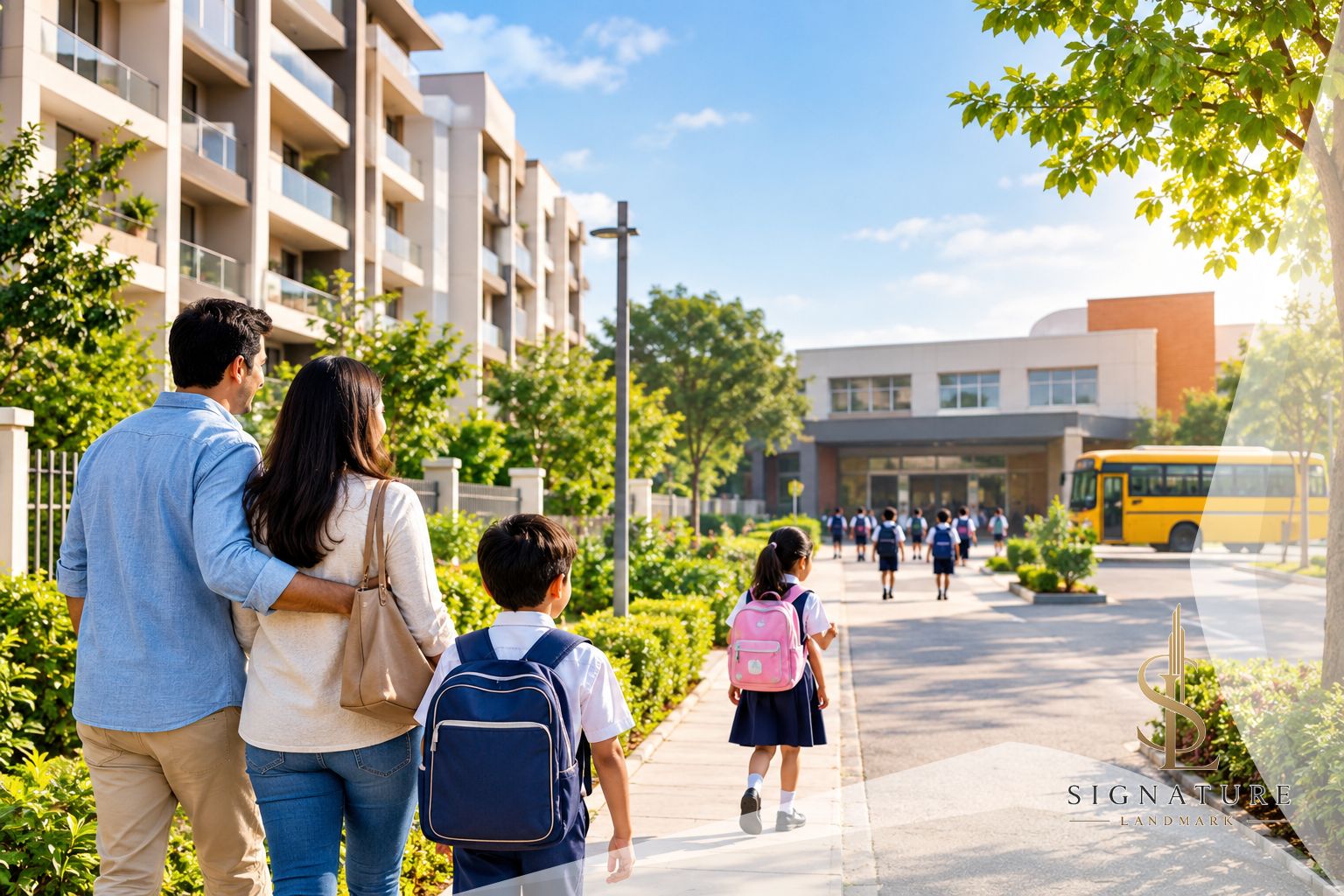

Choosing a home, buyers usually consider factors such as location, budget, connectivity, amenities, safety, and future property value. One of the most important factors for families with children is the availability of good schools near residential areas. Living close to a school can make daily life more convenient while also contributing to a comfortable and family-friendly lifestyle.
For homebuyers, especially families planning to stay in a property for many years, proximity to educational institutions can be an important part of the property-buying decision.
Why Schools Near Residential Areas Are Important
A residential area located close to schools can offer several practical advantages. Parents can save valuable time on daily school commutes, while children may have easier access to education and extracurricular activities.
Shorter travel distances can also reduce dependence on long daily journeys. This can be particularly useful in busy cities where traffic congestion can make commuting stressful and time-consuming.
For families, a home near a school can therefore provide a better balance between education, work, family time, and everyday activities.
Convenience for Parents and Children
One of the biggest benefits of having schools close to residential communities is convenience. Parents do not always have to spend significant amounts of time travelling with their children.
If the school is located within a reasonable distance, children may also have more opportunities to participate in school activities, sports, clubs, and other programs without worrying about long travel times.
For working parents, this convenience can be especially valuable. A shorter school commute can make morning and afternoon schedules easier to manage.
Safety and Accessibility
Safety is another important consideration when selecting a home for a family. Residential areas near established schools may offer better accessibility to educational facilities and surrounding services.
Parents should still carefully examine the roads, traffic conditions, pedestrian crossings, street lighting, and transportation options around the school and residential property.
A good residential location should ideally provide safe and convenient routes for children and parents.
Impact on Property Demand
Proximity to schools can also influence demand for residential properties. Families often prefer locations where reputed educational institutions are easily accessible.
Because of this demand, properties located near schools may attract more attention from family-oriented buyers and tenants. However, the actual impact on property value depends on several factors, including the reputation of the school, overall location, infrastructure, connectivity, neighborhood quality, and future development.
Therefore, buyers should consider school proximity as one factor within a broader property evaluation rather than relying on it alone.
Choosing the Right School Location
Not every school located nearby will necessarily be the right choice. Parents should research the educational institutions available around a residential area before purchasing a property.
Important factors to consider include:
- School reputation and academic environment
- Distance from the residential property
- Transportation facilities
- Safety and traffic conditions
- Sports and extracurricular facilities
- School timings
- Availability of different educational boards
- Future educational needs of children
It is also useful to visit schools personally and understand their facilities, admission procedures, and overall environment.
Schools and Community Development
Educational institutions can contribute to the development of residential neighborhoods. Areas with schools, colleges, healthcare facilities, shopping centers, parks, and public transportation often become attractive destinations for families.
As residential communities grow, supporting infrastructure may also develop around them. New roads, retail outlets, recreational facilities, and public services can improve the overall convenience of the neighborhood.
For homebuyers, examining both existing infrastructure and planned development is therefore important.
What Homebuyers Should Check Before Buying
Before purchasing a property near a school, buyers should look beyond the distance mentioned in a property advertisement.
Visit the location during school opening and closing hours to understand actual traffic conditions. Check whether roads become congested and whether parking creates problems.
Buyers should also consider noise levels, school buses, pedestrian movement, and road safety.
It is equally important to verify the property's legal documents, approvals, connectivity, water supply, electricity, drainage, and other essential facilities. School proximity should complement these fundamentals rather than replace them.
Benefits for Rental Property Owners
Properties near schools can also appeal to tenants with school-going children. Families who rent homes often prioritize convenient access to schools, workplaces, markets, healthcare facilities, and transportation.
A well-connected residential property near educational institutions may therefore have a wider potential tenant base. However, rental demand varies from one neighborhood to another, so investors should study local market conditions before making a decision.
Future Growth Matters
When purchasing a property, it is useful to consider not only schools that already exist but also future development in the surrounding area.
Upcoming educational institutions, improved roads, public transportation, and new residential projects can influence the attractiveness of a neighborhood over time.
However, buyers should verify claims about proposed developments through reliable sources rather than relying solely on advertisements or informal information.
Conclusion
Schools near residential areas can be an important advantage for families and property buyers. Convenient access to education can reduce daily commuting time, improve family convenience, and make a neighborhood more attractive to parents.
At the same time, buyers should evaluate the complete picture—including connectivity, safety, infrastructure, property quality, amenities, legal documentation, and future development.
The ideal residential location is not simply one that is close to a school. It is a place that provides a safe, convenient, well-connected, and comfortable environment for the entire family.
For homebuyers, taking time to research schools and other essential facilities before purchasing a property can help make a more informed and long-term real estate decision.