
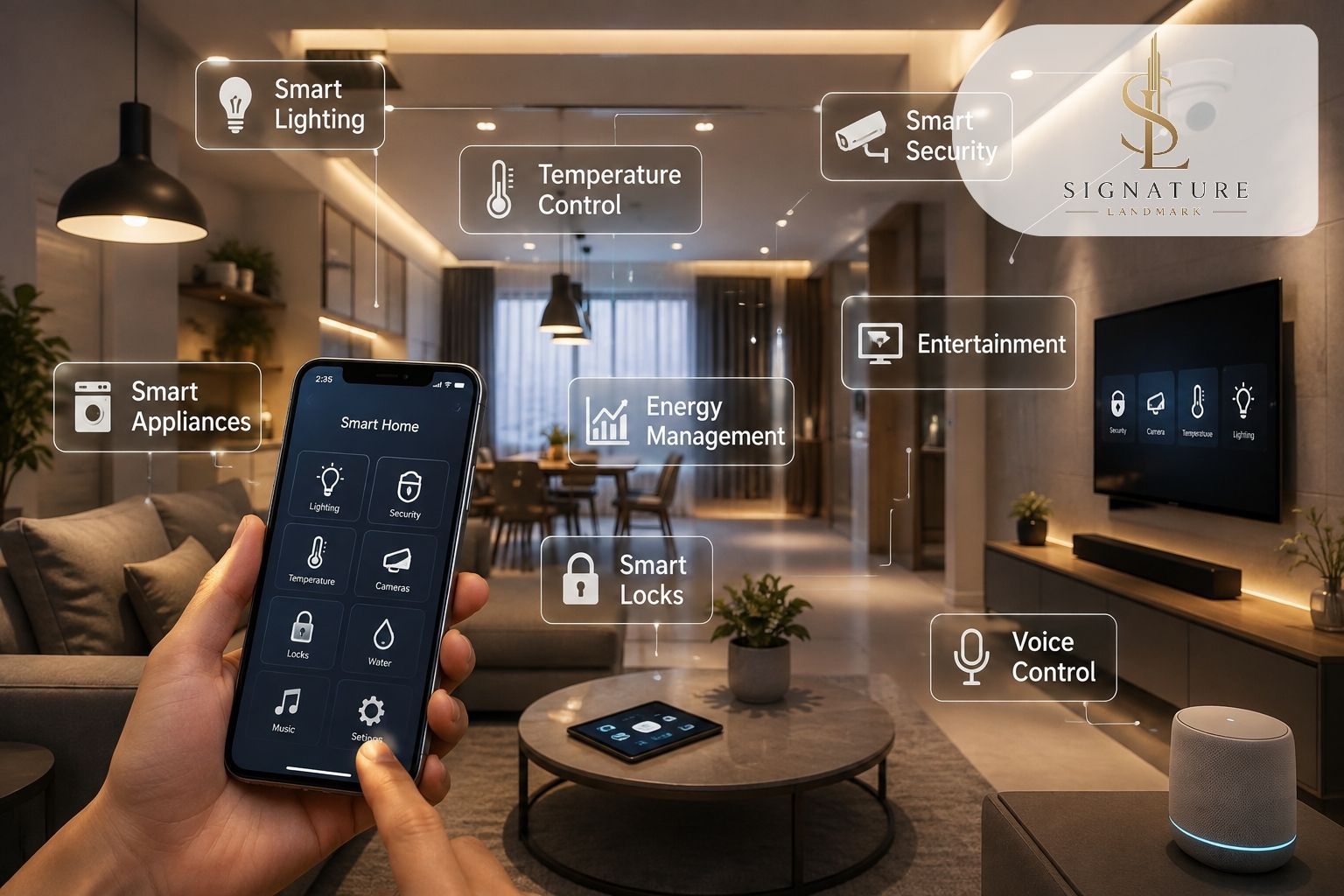

Smart homes are transforming the way people live. With the help of connected devices, automation, sensors, and mobile applications, homeowners can control many aspects of their property with greater convenience and efficiency. From smart lighting and security systems to automated appliances and energy management, smart home features are becoming an important part of modern residential properties.
For homebuyers and property investors, understanding these features can help in choosing a home that offers better comfort, security, and long-term value.
What Is a Smart Home?
A smart home is a property equipped with connected electronic devices that can communicate with each other and be controlled automatically or remotely. Many systems can be operated through a smartphone, tablet, voice assistant, or a centralized home automation system.
For example, homeowners can switch off lights remotely, monitor security cameras while away, adjust air conditioning, or receive alerts when unusual activity is detected.
1. Smart Lighting
Smart lighting is one of the simplest and most useful smart home features. Smart bulbs, switches, and lighting systems allow homeowners to control lights using smartphones, voice commands, or automated schedules.
Lights can be programmed to turn on or off at specific times. Motion sensors can also activate lights when someone enters a room. This not only improves convenience but can also help reduce unnecessary electricity consumption.
2. Smart Security Systems
Home security is a major priority for homeowners. Smart security technology provides better monitoring and control through devices such as smart cameras, video doorbells, motion sensors, and smart locks.
Security cameras can allow homeowners to view their property remotely. Smart doorbells can show who is at the door, while motion sensors can send instant alerts to a smartphone. These features provide homeowners with greater peace of mind, particularly when they are traveling or away from home.
3. Smart Door Locks
Smart locks provide an alternative to traditional keys. Depending on the system, homeowners may be able to unlock doors using a smartphone, PIN, fingerprint, or other digital methods.
Some smart locks can also create temporary access codes for guests or service providers. Homeowners can receive notifications when the door is locked or unlocked, making it easier to monitor access to the property.
4. Smart Thermostats and Climate Control
Smart thermostats can help manage indoor temperature more efficiently. They can learn household routines, follow programmed schedules, and sometimes adjust settings automatically based on occupancy.
For homes using air conditioning extensively, smart climate control can improve comfort while helping manage energy consumption. Homeowners can also adjust temperature settings remotely using their smartphones.
5. Smart Appliances
Modern appliances are increasingly becoming connected devices. Smart refrigerators, washing machines, ovens, air conditioners, and robotic vacuum cleaners can provide remote controls and notifications.
For example, a smart washing machine may notify the homeowner when a cycle is complete. A robotic vacuum cleaner can be scheduled to clean the home automatically, saving time and effort.
6. Voice-Controlled Home Automation
Voice assistants can make smart home systems easier to operate. Homeowners can use voice commands to control lights, appliances, music, temperature, and other compatible devices.
Instead of manually operating multiple switches, users can control several functions through simple commands. This can be particularly convenient for elderly family members or people with mobility challenges.
7. Smart Energy Management
Energy efficiency is becoming increasingly important for modern homeowners. Smart energy monitoring systems can provide information about electricity consumption and help identify devices that use excessive power.
Smart plugs and automated systems can switch devices off when they are not required. When combined with solar power or energy-efficient appliances, smart technology can contribute to better household energy management.
8. Smart Curtains and Blinds
Automated curtains and blinds can be controlled through schedules, mobile apps, or voice commands. They can be programmed to open in the morning and close in the evening.
Some advanced systems can respond to sunlight or temperature conditions. This can improve indoor comfort while potentially reducing the need for artificial lighting and excessive cooling.
9. Smart Water Management
Smart technology is also entering water management. Leak detection sensors can identify unusual water flow and alert homeowners before a small leak becomes a major problem.
Automated water systems can also help monitor usage. These features may be particularly useful for larger homes, villas, and properties where water management is important.
10. Smart Home Hubs and Automation
A smart home hub can connect multiple devices and allow them to work together. Instead of controlling every device separately, homeowners can create automated routines.
For example, a “Good Night” routine could switch off selected lights, lock doors, adjust the air conditioner, and activate security systems with one command. Such automation makes everyday living more convenient and organized.
Benefits of Smart Home Features
Smart home technology offers several benefits. Convenience is one of the biggest advantages because many household functions can be controlled remotely or automatically.
Smart cameras, locks, alarms, and sensors can also improve security. Energy efficiency is another benefit, as automated systems can reduce unnecessary electricity usage.
Smart features can also enhance a property's overall appeal. As technology becomes more common in residential developments, homes with well-integrated smart systems may attract buyers looking for modern lifestyles.
What Should Homebuyers Consider?
Before investing in smart home technology, buyers should consider compatibility, installation costs, maintenance, internet connectivity, privacy, and cybersecurity. It is also important to check whether different devices can work together through the same platform.
Homebuyers should focus on useful features rather than installing technology simply because it is trendy. A well-planned smart home should make everyday life easier, safer, and more efficient.
Conclusion
Smart home features are becoming an important part of modern residential living. From intelligent lighting and security systems to smart appliances, energy monitoring, and automated climate control, technology can significantly improve comfort and convenience.
For today's homebuyers, a smart home is not just about advanced gadgets—it is about creating a safer, more efficient, and more comfortable living environment. As residential technology continues to evolve, smart features are likely to become an increasingly valuable part of modern homes.